Dangerous Links: Cross-Border Kin and Forced Displacement from a Spatial Perspective
Why do some groups become targets of ethnic cleansing, while others do not?
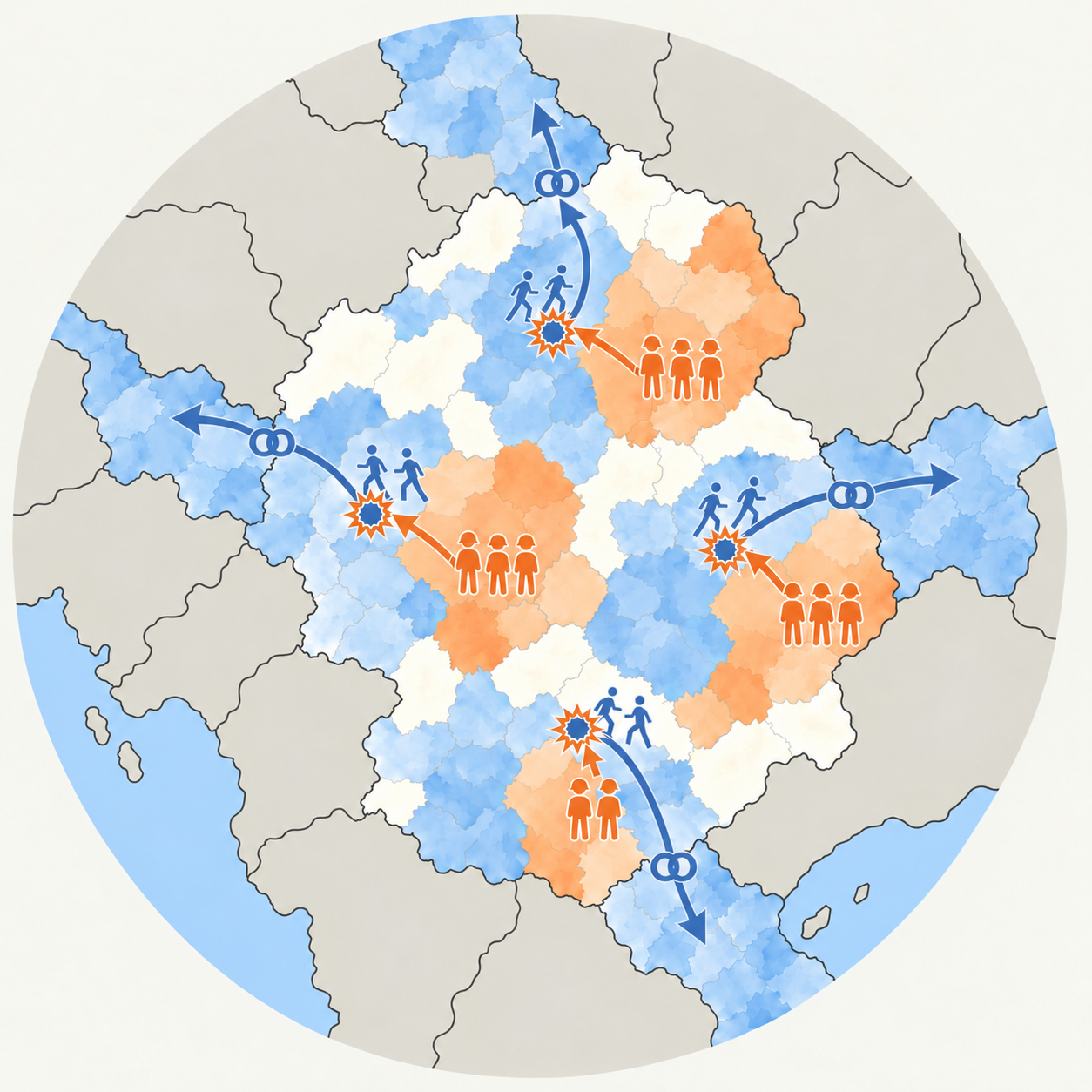
Examples around the globe show that perpetrators often uproot ethnic groups with kin communities in neighboring states.
Going beyond state-centric research, I argue that transnational ethnic ties can make groups appear as a “dual threat” to governments: their networks can facilitate rebellion and territorial secession. Exclusionary governments therefore have incentives to forcibly remove these groups from strategic territories.
Combining new geo-located data on ethnic cleansing (1990–2021) with maps of ethnic group settlements in a difference-in-differences analysis, I show that groups with cross-border links face a higher risk of ethnic cleansing, particularly when their kin lose political power in neighboring states. Using causal mediation analysis, I find that claims for self-determination form one mechanism linking cross-border ties to displacement.
This demonstrates transnational ethnic networks help explain why some ethnic groups become targets of ethnic cleansing and when they may do so. Rather than treating ethnicity as contained within states, I highlight that international borders can cut across ethnic communities without necessarily dividing their identities and networks.